On November 20, 2025, Beijing time, the prestigious international journal Nature published online a research paper titled “Electro-generated excitons for tunable lanthanide electroluminescence”, with Heilongjiang University as the primary affiliation and Professors Xu Hui and Han Chunmiao from the School of Chemistry and Materials Science as co-corresponding authors. The study introduces a new electroluminescence mechanism based on an organic-inorganic hybrid system, overcoming the long-standing challenge of charge injection into insulating lanthanide-doped nanocrystals.
Figure 1. Screenshot of the paper on Nature's website
Electroluminescence (EL), which directly converts electrical energy into light, serves as a key technology in modern displays and lighting systems. Innovation in EL material are central to advancing these industries. Lanthanide-doped nanocrystals (Ln-NCs) are considered promising candidates for next-generation luminescent materials due to their high color purity, excellent stability, and broad spectral tunability. However, their intrinsic insulating nature prevents efficient charge injection, severely limiting their application in EL devices and presenting a persistent scientific challenge.
To address this issue, a collaborative team led by Professors Xu Hui and Han Chunmiao from Heilongjiang University, Associate Professor Han Sanyang from Tsinghua Shenzhen International Graduate School, and Academician Liu Xiaogang from the National University of Singapore developed an effective strategy combing organic semiconductor ligands with lanthanide-doped nanocrystals, achieving highly efficient electroluminescence from the otherwise insulating nanocrystals.
Moving beyond conventional charge injection approaches, the team designed and synthesized a series of aryl phosphine oxide carboxylic acid derivatives as functional ligands. These ligands firmly anchor to the Ln-NCs surface via carboxyl groups. Under an electric field, they first capture electrons and holes to form excitons, then deliver energy to the lanthanide emission centers inside the nanocrystals via an ultrafast (<1 ns) and highly efficient interfacial energy transfer process, exhibiting an intersystem crossing efficiency of 98.6%. The optimized ligand CzPPOA achieved a remarkable triplet energy transfer efficiency of 96.7%, effectively bypassing the insulating barrier and enabling spectrally pure, color-tunable lanthanide ion emisison.
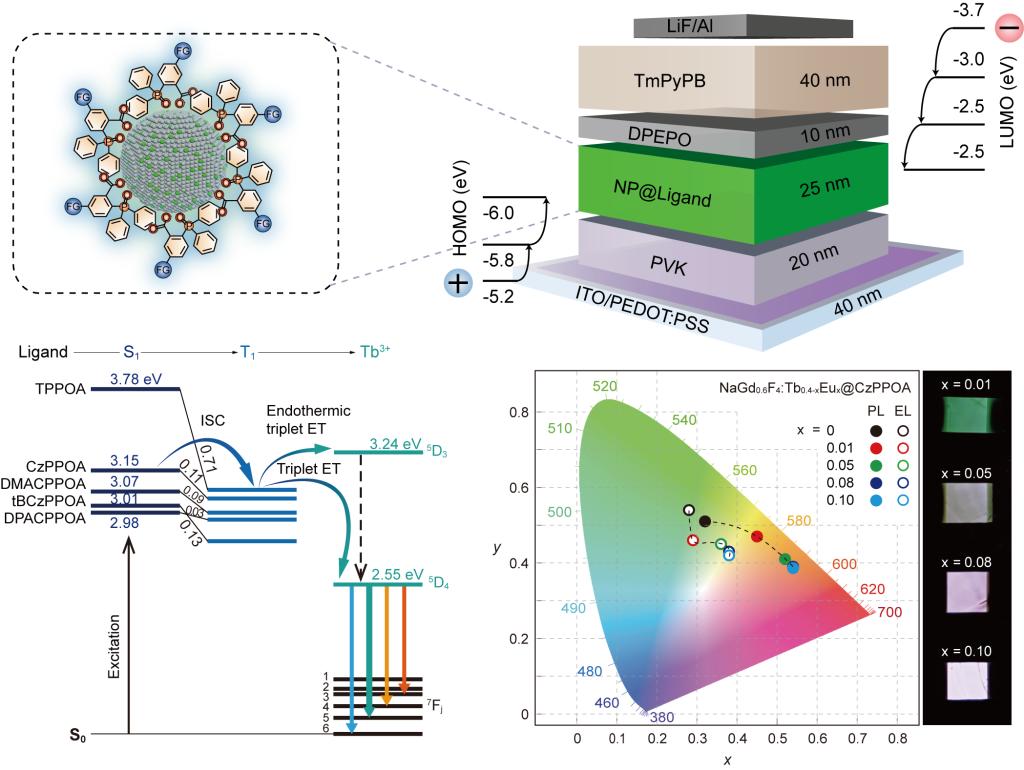
Figure 2. Design of the organic-inorganic hybrid luminescent unit and energy transfer mechanism. Image provided by the research team.
Electroluminescent devices constructed using this strategy demonstrated breakthrough performance:
Substantial Efficiency Gains: A Tb³⁺-based green-emitting device achieved an external quantum efficiency (EQE) of 5.9%, representing a 76-fold enhancement over unmodified nanocrystals, with an exciton utilization efficiency of 88%.
Flexible Spectral Tuning: By varying the type and concentration of doped ions (e.g., Eu3+, Nd3+) within an identical device structure, the team leveraged the rich 4f energy levels of lanthanide ions to achieve continuous and precise color tuning across green, warm white, and near-infrared emission.
Clear Mechanism Elucidated: Systematic transient spectroscopy analysis provided deep insight into the physical mechanism of the ultrafast interfacial energy transfer, offering a theoretical foundation for future material design and optimization.
This study signifies more than realization of efficient electroluminescence in insulating lanthanide nanocrystals:
It opens a new pathway for achieving electroluminescence in a range of high-performance luminescent materials previously limited by their insulating characteristics.
It demonstrates a new paradigm for performance optimization through organic-inorganic functional hybridization, with implications for cross-disciplinary research in energy, biomedicine, and other fields.
It broadens application prospects, laying a material foundation for developing low-cost, wide-color-gamut ultra-high-definition displays and specialized devices for near-infrared communication and bioimaging.
Paper Information
Title: Electro-generated excitons for tunable lanthanide electroluminescence
Corresponding Authors: Liu Xiaogang (National University of Singapore), Xu Hui, Han Chunmiao (Heilongjiang University), Han Sanyang (Tsinghua SIGS)
First Authors: Tan Jing (Heilongjiang University), Zhang Peng (Tsinghua SIGS), Song Xiaoqing (Heilongjiang University)
Other Authors: Zhang Jing, Duan Chunbo (Heilongjiang University), Wang Feng (City University of Hong Kong), Zhang Zhilong (South China University of Technology)
Link to the paper: https://www.nature.com/articles/s41586-025-09717-1






 0451-86608114
 0451-86608114
 No. 74 Xuefu Road, Harbin City, Heilongjiang Province
 中文
中文